METHOD
Control of Atomically Thin Materials
Stacking · Microfabrication · Field control
Exfoliation, Microfabrication, and Device Fabrication
Making atomically thin samples and devices by mechanical exfoliation
Layered van der Waals crystals, whose layers are held together by van der Waals forces, can be mechanically exfoliated using adhesive tape to obtain samples from a single layer to a few atomic layers thick. These atomically thin materials often exhibit properties different from those of their bulk crystals. Graphene, obtained by exfoliating graphite, is the best-known example; many other atomically thin materials have since been discovered, including materials with distinctive magnetic order or superconductivity in the atomically thin limit.
Microfabrication and device integration can further control the properties of atomically thin materials and enable distinctive functions. Our laboratory studies and controls the characteristic quantum states of atomically thin samples and devices.

Fabricating van der Waals Interfaces
Creating unique interfaces by freely stacking atomically thin materials
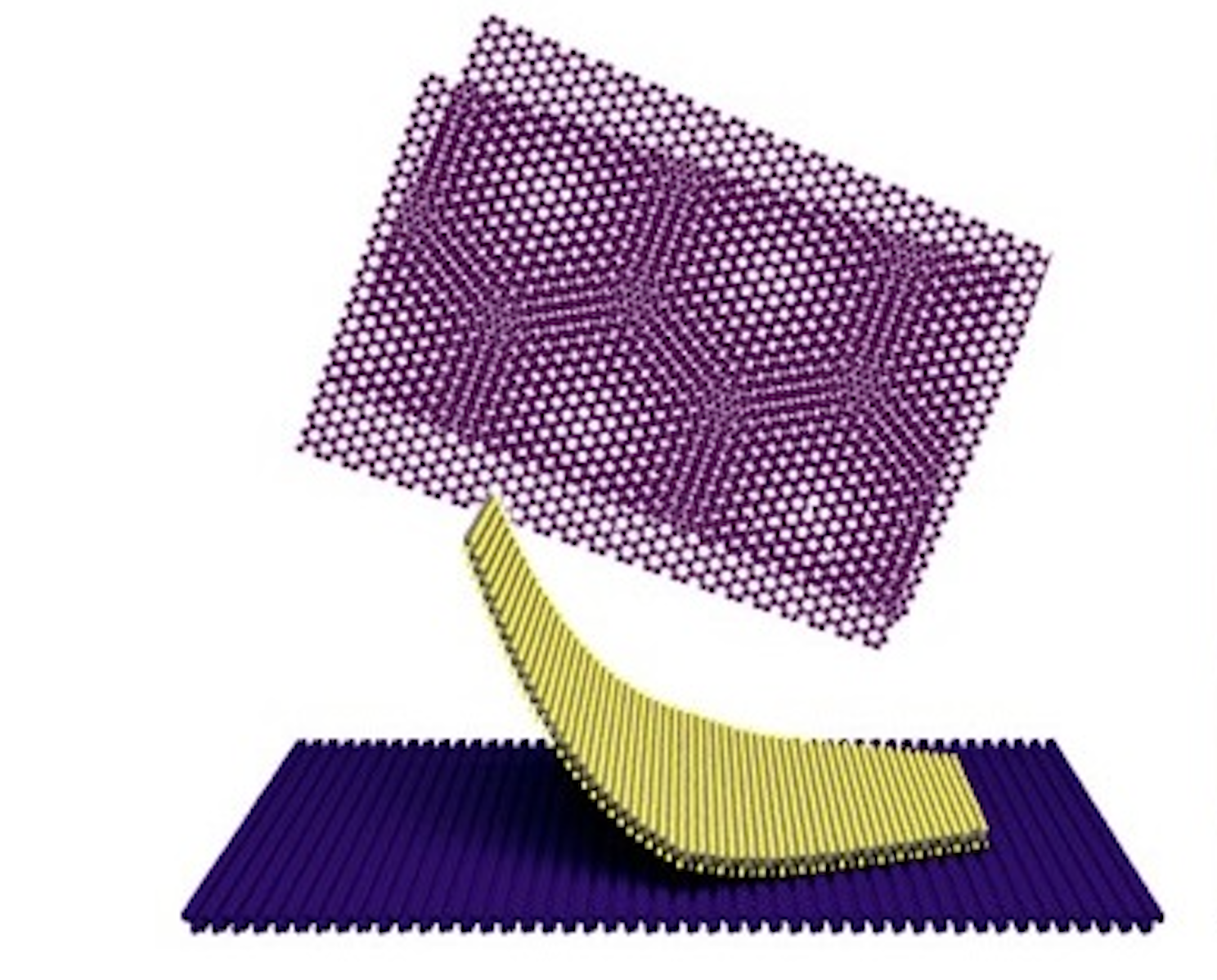
Atomically thin materials can be freely stacked to create heterostructures and twisted interfaces, without being constrained by the symmetry or lattice matching of their crystal structures. Novel properties emerging at such van der Waals interfaces are attracting considerable interest worldwide.
Using a transfer and stacking system inside a glovebox, our laboratory fabricates unique interfaces from a wide range of atomically thin materials, including air-sensitive materials. We explore new properties and functions specific to van der Waals interfaces.
Applying External Fields
Controlling symmetry by applying large strains
Atomically thin materials are highly flexible in-plane and can be subjected to large strains. By applying large strains, we control their electronic states and symmetry—for example, inducing electric polarization or magnetization—and pursue large changes in their physical properties and new strain-induced phenomena.

Controlling Quantum States with Electric Fields
Controlling quantum states by applying electric fields
Strong electric fields can also be applied to the surfaces and interfaces of atomically thin materials, enabling control of their physical properties and the development of new functions. Our laboratory uses field-effect devices based on atomically thin materials to control quantum states, including superconducting and magnetic states.
